In the second of a four-part series covering key themes from our Student Recruitment Report 2026, Claire Tyler considers how employers are managing record levels of applications while rethinking how they recruit and select talent.
Competition for early careers opportunities remains intense, with employers receiving large volumes of applications across graduate, school and college leaver, and internship programmes.
This year’s Student Recruitment Report found employers receive an average of 141 applications per graduate vacancy, 96 per school and college leaver vacancy and 102 per internship opportunity.
Adding to the pressure, this year 62% of employers reported an increase in graduates applying for roles targeted at school and college leavers, up from 40% last year.
Managing these application volumes has become a strategic concern for employers. Nearly three-quarters of respondents (73%) expect high application volumes to be a challenge in the next recruitment season, while 60% identify managing application volumes as a top concern for the next five years.
How are employers managing mass applications?
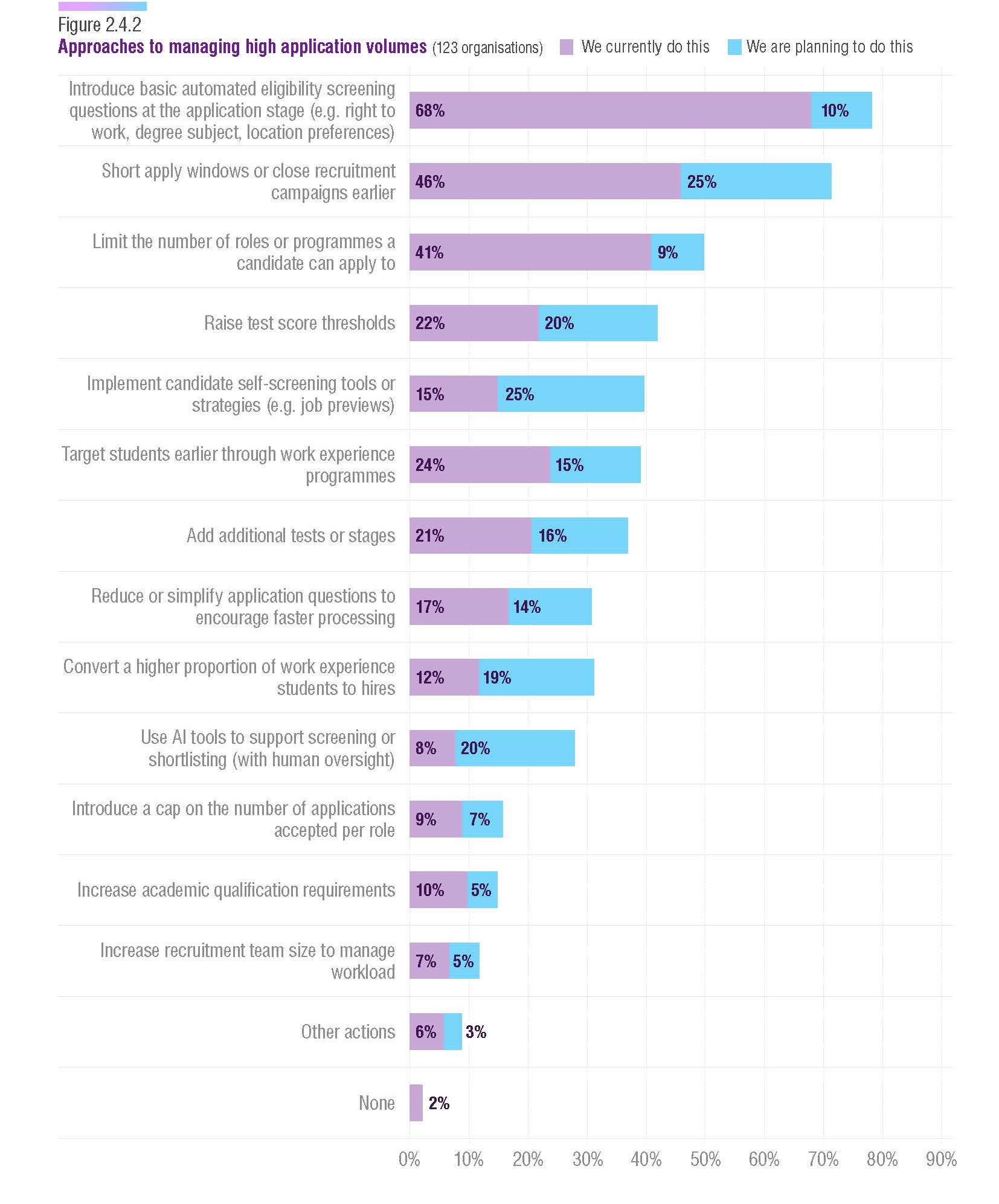
High application volumes are also influencing how employers approach recruitment (Figure 2.4.2).
Employers have already been responding in a range of ways, including implementing automated eligibility screening (68%), using shorter application windows or earlier campaign closures (46%), and limiting the number of roles or programmes to which individual candidates can apply (41%).
In future, a further quarter of employers are also looking to implement candidate self-screening tools (25%) and shorter application windows or earlier campaign closures to manage this challenge (25%).
Raising test score thresholds, adding additional tests or stages and targeting students earlier through work experience programmes are also popular approaches to managing high demand for opportunities.
Importantly, this is not simply a story about employers responding to candidate use of AI. While AI-supported screening and shortlisting is one approach being considered, it sits within a much broader set of changes aimed at managing recruitment at scale. Overall, 28% of employers are either already using or planning to use AI tools to help manage application volumes.
There is also ongoing debate about whether employers will increasingly rely on minimum academic requirements to reduce applicant numbers. However, the survey suggests this remains relatively uncommon.
Just 15% of employers are currently using, or planning to use, higher academic criteria as a volume-management tool. Employers are considerably more likely to increase assessment thresholds, with 42% taking this approach.
Future recruitment models
Looking further ahead, employers are increasingly looking to data and technology, skills-based hiring and alternative recruitment models to manage demand efficiently and fairly.
Our survey found that over the next three to five years, 45% expect increased use of data and technology in recruitment decision-making, 43% anticipate greater use of skills-based hiring, 30% expect a rebalancing of talent pipelines and 25% foresee changes to traditional cohort-based recruitment models. A further 22% expect to place greater emphasis on candidate conversion rather than attraction.
Despite managing the pressure of growing application volumes, employers continue to fill almost all vacancies and remain highly satisfied with candidate quality, a sign that this is an employer led, rather than student led, market.
Satisfaction with school and college leavers in particular has increased, as 97% of employers reported that they could often or almost always recruit candidates of the desired quality, up from 85% last year.
Fair access to opportunity
As recruitment processes evolve, it will be important to consider the impact of these approaches on underrepresented groups.
Earlier campaign closures can disadvantage candidates who hear about opportunities later or require more time to prepare applications. Higher test thresholds may favour those with greater access to preparation resources, while poorly designed self-screening tools could discourage capable applicants from putting themselves forward.
The challenge for employers is therefore to manage volume efficiently without creating additional barriers to opportunity.
ISE members can explore sector-specific data about these themes in the new Student Recruitment Report 2026 dashboards.
Read the first of our Student Recruitment Report in-depth series on What the ‘stabilised’ graduate market really looks like