AI is transforming recruitment faster than employers are adopting it. Claire Tyler, ISE Head of Insights, explores how employers are using technology in hiring.
In this year’s ISE Student Recruitment Report half of employers identified the influence of AI and automation on recruitment processes as one of their top concerns for the next five years.
While only 16% of employers currently use AI in recruitment, and 52% have no plans to use it, 77% say they are already redesigning or reviewing recruitment processes in response to candidate use of generative AI.
The influence of AI therefore extends well beyond the organisations actively deploying the technology in their recruitment process.
Employer attitudes towards candidate use of AI are also evolving. Nearly two-thirds (64%) are now comfortable with candidates using AI at some stage of the recruitment process, up from 46% last year, while 82% provide guidance on its appropriate use, compared with 55% in 2025.
However, concerns about assessment integrity continue to grow, with 92% of employers reporting suspected or identified cheating (up from 85% in 2025 and 78% in 2024) and 66% identifying unauthorised AI use during interviews (up from 61% last year).
AI-resilient recruitment
These findings show that the priority for many employers is not AI-driven recruitment, but AI-resilient recruitment.
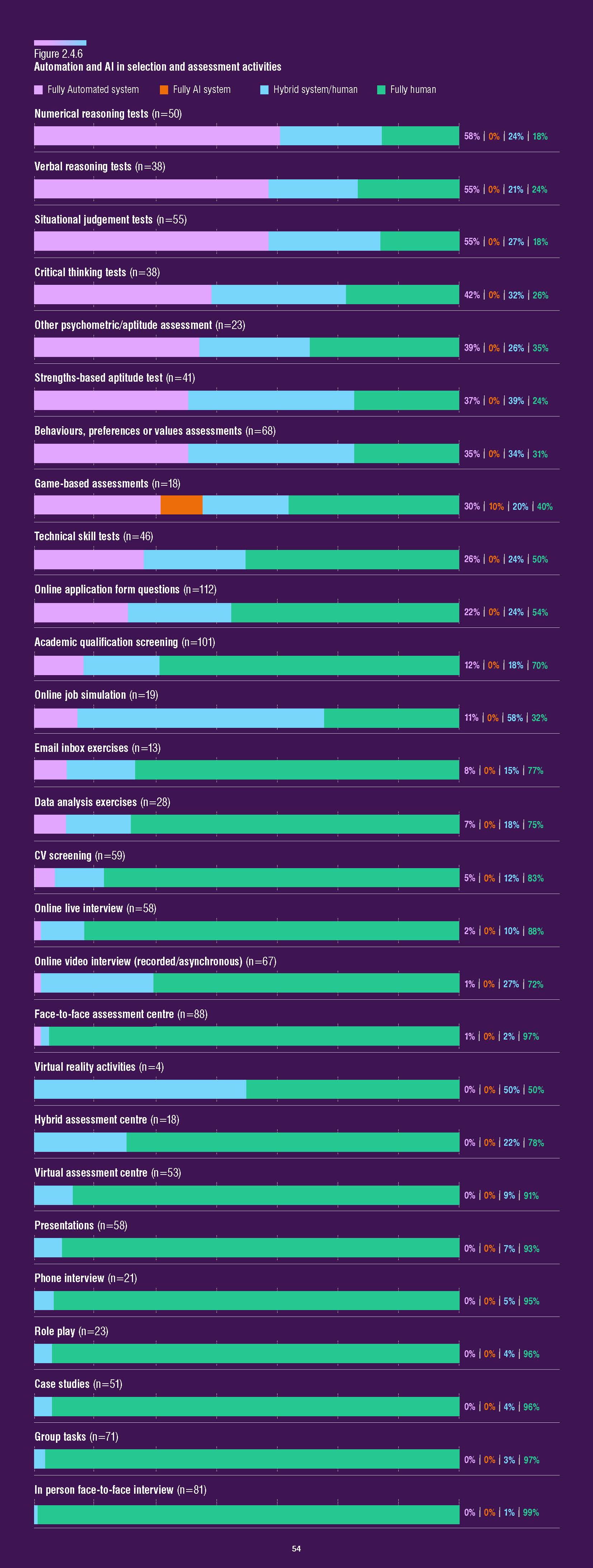
AI is already changing how employers assess talent, yet fully AI-led selection remains uncommon. Even in the most advanced area, only 10% of game-based assessments are fully AI-driven. However, AI adoption is likely to accelerate, with a further 29% of employers planning to introduce AI into recruitment within the next year.
This is not simply a case of employers managing candidate use of AI by adopting AI themselves.
Using AI tools to support screening or shortlisting is only one of a range of measures adopted by employers to manage the current high demand for early career opportunities, with 28% of employers either currently using or planning to use them.
In practice, non-AI approaches remain more common, at least for now. Employers are increasingly using automated screening questions, shortening application windows, limiting the number of programmes candidates can apply for, raising assessment thresholds and introducing self-screening tools that help applicants assess their suitability before applying. These measures reflect a broader effort to manage high candidate demand.
However, AI offers additional advantages, including faster processing, greater consistency and the potential to provide personalised candidate feedback at scale. As a result, AI is likely to become an increasingly important feature of graduate recruitment over the coming years.
How employers are using technology in recruitment
Currently, automation is far more established than AI in selection processes. Many employers use automated tools throughout the process, particularly for structured testing. More than half of numerical reasoning tests, situational judgement tests and verbal reasoning tests are automated, demonstrating that technology-enabled assessment is already commonplace even where AI adoption remains limited (Figure 2.4.6).
Figure 2.4.6: Automation and AI in selection and assessment activities
Some employers are also using AI and other technologies to improve how candidates are matched to roles. While adoption here remains relatively limited, technology is most commonly used to support shortlisting and hiring decisions (25% of employers) to help recruiters identify suitable candidates from large applicant pools.
Other employers use technology to support candidate self-selection, directing applicants towards roles that best match their skills, interests and preferences. AI currently plays a relatively small role in these activities (4-11% of employers). However, the findings suggest growing interest in using technology to help candidates find better-fit opportunities and improve the efficiency of recruitment processes.
This shift is reflected in how employers expect their recruitment approaches to evolve over the next three to five years. Increased use of data and technology in recruitment decision-making was the most commonly anticipated change, cited by 45% of employers.
As high application volumes continue to be an issue, employers are increasingly focused on using technology not only to process large volumes of candidates more efficiently, but to improve how talent is identified, assessed and matched to opportunities.
ISE members can explore sector-specific data on these themes in the new Student Recruitment Report 2026 dashboards.
This is the third of a four-part series covering key themes from ISE’s Student Recruitment Survey 2026. Read How mass applications are changing early careers recruitment and What the ‘stabilised’ graduate market really looks like.